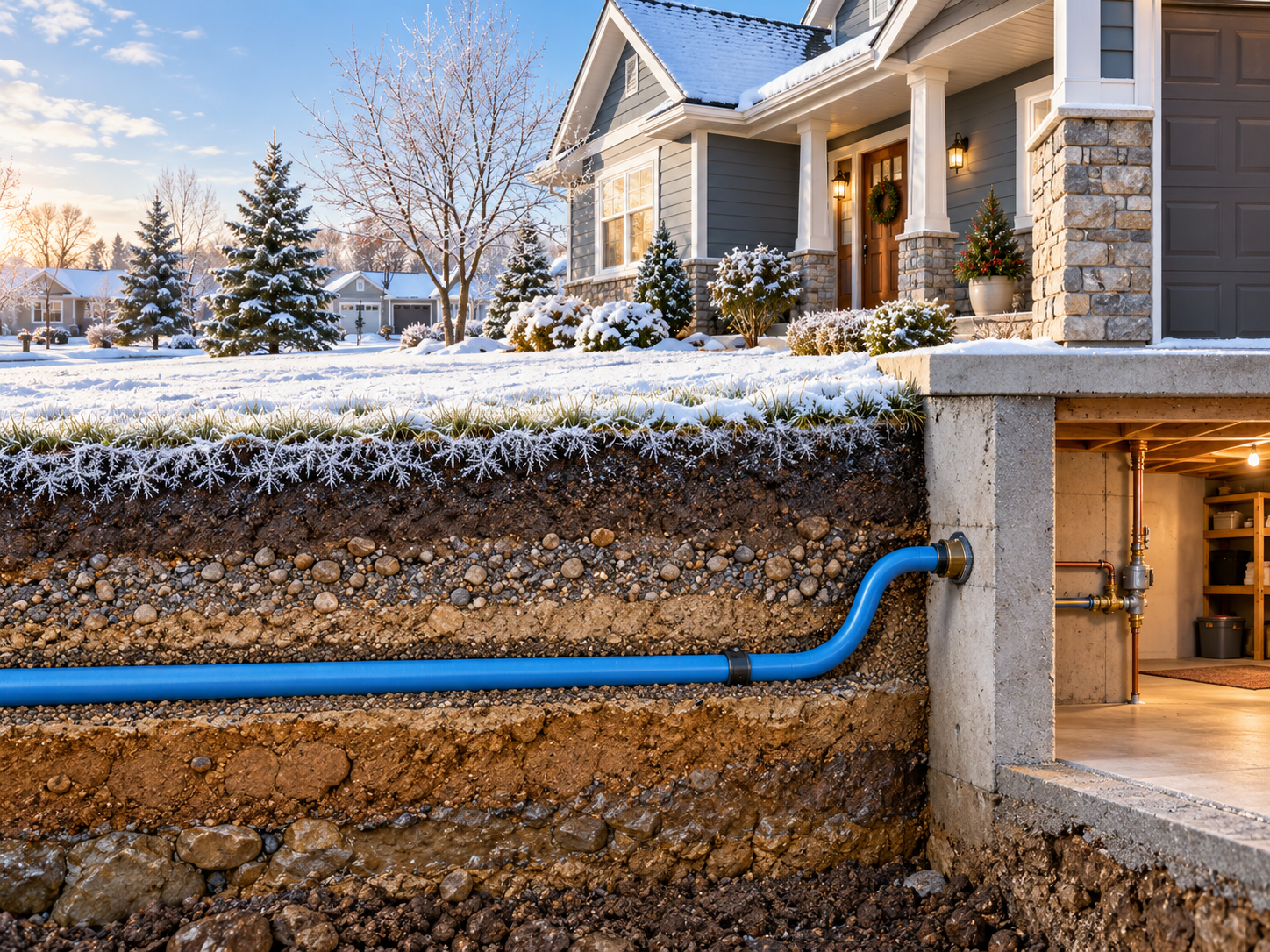
In freezing climates, a buried water service line usually needs to be installed below the local frost line. A common code baseline is at least 12 inches below grade and at least 6 inches below the frost line, but local amendments, utility requirements, soil conditions, and site details can require more depth. Warm-climate locations may not need deep frost burial for freeze protection, but they can still have minimum-cover rules. Use statewide frost-depth ranges for early planning only, then confirm the exact trench depth before digging.
Why Frost Line Matters for Water Lines
A water service line carries water from the main or private well toward the house. If that line sits too high in freezing ground, the soil around it can freeze and the water inside the pipe can freeze as well.
For an independent starting number before you compare local quotes, use the remodel cost calculator. Treat it as a planning range, then replace assumptions with project-specific bids and local requirements.
That is why frost depth matters. It is not only a footing question. It is also one of the main planning numbers for buried plumbing lines outside the house.
The General Code Rule Homeowners Should Know
A widely used plumbing rule says that exterior water service piping in freezing climates should be installed not less than 12 inches below grade and not less than 6 inches below the frost line. The same general code approach also requires water, soil, and waste pipes exposed to freezing temperatures to be protected by insulation, heat, or both where needed.
That does not mean every city uses exactly the same number. Local jurisdictions can amend model code, utilities can impose deeper installation standards, and cold regions often use trench depths that go well beyond the minimum wording in model text.
Typical Planning Ranges by State
The table below is for planning only. It shows typical frost-depth ranges that often influence buried water-line depth. It does not replace the locally required trench depth for a specific address.
| State | Typical frost-depth planning range | What it means for water lines |
|---|---|---|
| Alabama | 6–12 in. | Freeze risk is usually modest, but local minimum cover still applies. |
| Alaska | 42–120+ in. | Water-line depth can be extensive and may require specialized local design. |
| Arizona | 0–30+ in. | Desert areas differ sharply from colder high-elevation locations. |
| Arkansas | 12–18 in. | Use local frost depth and utility requirements before trenching. |
| California | 0–30+ in. | Coastal areas can be shallow while mountain communities can require much more cover. |
| Colorado | 30–48+ in. | High elevation commonly pushes trench depth much deeper. |
| Connecticut | 42–48 in. | Expect a meaningful below-frost trench in most locations. |
| Delaware | 18–24 in. | Local utility standards can be more specific than general frost maps. |
| Florida | 0 in. | Freeze depth is usually not the control, but minimum burial depth can still apply. |
| Georgia | 6–12 in. | Northern areas can be colder than the metro or coastal regions. |
| Hawaii | 0 in. | Frost usually does not control water-line depth at normal developed elevations. |
| Idaho | 24–48+ in. | Expect wide variation between valleys and cold northern or mountain areas. |
| Illinois | 30–42 in. | Local frost depth often drives deeper water service trenches. |
| Indiana | 24–36 in. | Northern Indiana usually needs more depth than southern counties. |
| Iowa | 42–48 in. | Deep seasonal freezing makes proper burial especially important. |
| Kansas | 24–36 in. | Western and northern areas can trend deeper. |
| Kentucky | 12–24 in. | Depth varies by region and elevation. |
| Louisiana | 0–12 in. | Minimum cover rules are usually more important than frost depth. |
| Maine | 48–60+ in. | Plan for very deep freeze protection. |
| Maryland | 18–30 in. | Western Maryland is notably colder than the coastal plain. |
| Massachusetts | 36–48 in. | Expect deeper trenching than in many Mid-Atlantic locations. |
| Michigan | 42–60 in. | Cold regions and the Upper Peninsula can require very deep burial. |
| Minnesota | 42–60+ in. | Water service freeze protection is a major planning issue. |
| Mississippi | 0–12 in. | Frost may be minor, but utility depth requirements still matter. |
| Missouri | 18–36 in. | Use local numbers rather than statewide assumptions. |
| Montana | 36–60+ in. | Cold climate and elevation can require deep trenching. |
| Nebraska | 36–42 in. | Expect a meaningful below-frost installation in many areas. |
| Nevada | 0–30+ in. | Southern Nevada differs greatly from colder northern zones. |
| New Hampshire | 48–60 in. | Deep seasonal frost can drive water-line burial depth. |
| New Jersey | 24–36 in. | Northern areas generally go deeper. |
| New Mexico | 12–30+ in. | High elevation can change the trench depth completely. |
| New York | 36–60 in. | Use local criteria rather than a single statewide number. |
| North Carolina | 6–18 in. | Mountain counties can be much colder than coastal areas. |
| North Dakota | 48–60+ in. | One of the deeper water-line burial climates in the lower 48. |
| Ohio | 24–42 in. | Water service depth often differs between north and south. |
| Oklahoma | 12–24 in. | Panhandle and northern areas can freeze deeper. |
| Oregon | 0–24+ in. | Coast, high desert, and mountain areas behave very differently. |
| Pennsylvania | 30–42 in. | Expect a meaningful below-frost trench in many areas. |
| Rhode Island | 36–42 in. | Water line freeze protection is a routine planning factor. |
| South Carolina | 6–12 in. | Shallow in many areas, deeper in colder inland zones. |
| South Dakota | 42–60 in. | Deep frost protection is common. |
| Tennessee | 12–24 in. | Higher elevations require more caution. |
| Texas | 0–12+ in. | Coastal Texas differs sharply from colder northern and Panhandle areas. |
| Utah | 12–36+ in. | Water-line depth changes significantly with elevation and region. |
| Vermont | 48–60 in. | Deep frost is a standard design condition. |
| Virginia | 12–24 in. | Coastal and inland locations can differ noticeably. |
| Washington | 0–24+ in. | Puget Sound is milder than eastern Washington and mountain zones. |
| West Virginia | 24–36 in. | Higher elevations can require more cover. |
| Wisconsin | 42–60 in. | Frozen-ground depth can drive very deep service trenches. |
| Wyoming | 36–60+ in. | Cold winters and elevation can produce substantial frost depth. |
Not Every Water Pipe Follows the Same Logic
Homeowners often say “water line” when they mean different things. The rules can vary depending on what pipe you are talking about.
Main water service line
The buried line from the main or well to the house. This is the line most directly tied to frost depth and minimum cover rules.
Irrigation and outdoor water lines
These can follow different standards, especially if they are seasonal systems meant to be drained before winter.
Interior supply pipes near cold zones
Pipes in exterior walls, attics, crawl spaces, garages, and unconditioned basements may need insulation or heat, even if the underground service line is correctly buried.
Sewer and drain piping
Drainage lines are a different system. Do not assume potable water-service depth is the same as sewer depth.
What Else Changes the Required Depth?
- Local code adoption: your city or county may amend the base plumbing code.
- Water utility standards: public utilities sometimes publish their own service-line requirements.
- Climate and frost depth: the colder the ground conditions, the deeper the trench often becomes.
- Site exposure: wind-scoured soil, steep grades, or areas with little snow cover can freeze differently.
- Entry into the house: the line still needs a sensible protected route where it passes through the foundation and into conditioned space.
- Approved alternative protection: insulation, heat trace, or other methods may be allowed in some situations, but only when approved.
How to Find the Exact Water-Line Depth for Your Property
- Identify who governs the work.
For one property that may be the city plumbing inspector. For another it may be the county building department or a rural water utility. - Ask two separate questions.
First: what is the local frost depth? Second: what burial depth is required for a water service line at this address? - Check if the utility has its own standard.
Many utilities care about service line material, curb-stop location, separation from other utilities, and minimum cover. - Confirm whether you are replacing or installing new service.
Replacement work can trigger different expectations than a repair or a temporary line. - Verify before trenching.
It is much cheaper to confirm the depth on paper than to re-dig a long trench after inspection.
Practical Planning Tips Before You Dig
- Choose the final route before landscaping, hardscaping, or driveway work begins.
- Call for utility locating before excavation.
- Do not rely on a neighbor’s depth unless the same authority confirmed it for your property too.
- Pay attention to the house entry point, not just the middle of the trench.
- If part of the run passes through an unheated crawl space or garage, plan freeze protection there too.
- Ask whether inspection is required before backfill.
Verify Before You Build
Use these primary references to verify code, safety, energy, or contractor-planning details. Local rules, adopted code editions, manufacturer instructions, and project conditions still control.
Water-Line Depth FAQs
How deep should a water line be buried?
In freezing climates, exterior water service piping is often buried at least 12 inches below grade and at least 6 inches below the local frost line, but local standards can require more.
Is water-line burial depth the same as frost depth?
No. Frost depth is one of the main factors, but minimum cover and local utility standards can make the final required trench depth deeper.
Can insulation replace trench depth?
Sometimes, but only when an approved design or the local authority allows it. In many situations the simplest approach is still burying the line below frost depth.
Do pipes inside the house need freeze protection too?
Yes. Pipes in areas subject to freezing temperatures such as exterior walls, attics, crawl spaces, and other cold zones often need insulation, heat, or both.
Who can tell me the exact depth for my address?
The best sources are the local plumbing/building department and the utility that serves the property. Use them before trenching, not after.