Quick Answer
The same fixture move can have completely different economics on slab versus crawlspace. A simple wet-wall shift may begin around $800–$1,500 per fixture, while cutting and rebuilding a concrete slab can add roughly $150–$350 per linear foot before finish restoration.
1. Start With the Fixture Relocation Baseline
For a simple move near an existing wet wall, a broad planning baseline of $800–$1,500 per fixture can be useful. This is before major concrete work, structural repair, permits and finish restoration.
For an independent starting number before you compare local quotes, use the remodel cost calculator. Treat it as a planning range, then replace assumptions with project-specific bids and local requirements.
2. Slab Trenching Is a Linear-Foot Cost Problem
Trench Length × $150–$350/ft = Broad Cutting / Excavation / Backfill RangeClarify whether scanning, saw cutting, concrete removal, excavation, pipe installation, testing, backfill, doweling and slab patching are included.
3. Crawlspace Routing Changes the Labor Profile
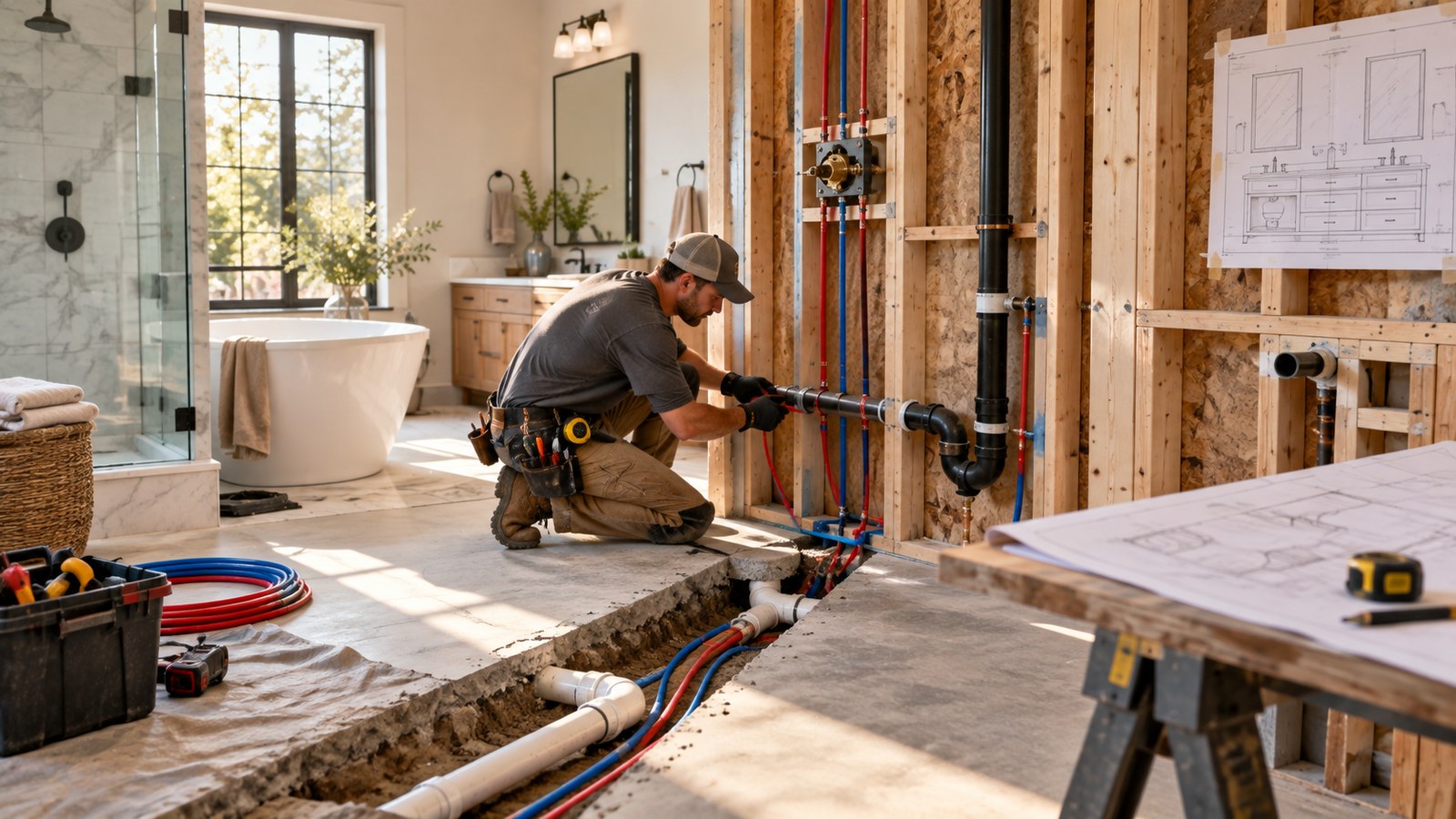
With usable crawlspace access, plumbers can often route drains and water lines below the floor instead of demolishing concrete. Tight clearances, wet soil, insulation removal or poor access can erase some of that advantage.
| Condition | Budget Effect |
|---|---|
| Open crawlspace | Lower demolition and easier future service. |
| Low / obstructed crawl | Slower labor and access costs. |
| Slab-on-grade | Cutting, excavation and restoration dominate the move. |
4. Price Drain, Vent and Water Separately
Drain lines need slope. Vent lines must reconnect correctly. Water lines may be copper or PEX, each with different labor and material profiles. A quote that only says “move plumbing” can hide which systems are included.
5. Tankless Conversion Is a System Upgrade
- Tankless unit
- Possible larger gas line
- Exterior wall or roof venting
- Combustion-air requirements where applicable
- Condensate drain for condensing units
- Electrical receptacle / controls
- Water isolation and service valves
6. Worked Example: Move Two Fixtures Across 12 ft of Slab
| Line Item | Low | High |
|---|---|---|
| 2 fixture relocations | $1,600 | $3,000 |
| 12 ft slab trench | $1,800 | $4,200 |
| Vent / water extension | $800 | $1,800 |
| Finish restoration | $1,000 | $2,500 |
| Planning total | $5,200 | $11,500 |
Verify Before You Build
Use these primary references to verify code, safety, energy, or contractor-planning details. Local rules, adopted code editions, manufacturer instructions, and project conditions still control.
Frequently Asked Questions
How much does it cost to move a plumbing fixture on a standard wet wall?
A broad planning baseline around $800 to $1,500 per fixture can be useful for a relatively simple shift with accessible plumbing, before major slab work or finish restoration.
How much does slab trenching cost?
A broad planning range of roughly $150 to $350 per linear foot can be useful for cutting, excavation, trenching and backfilling, but depth, reinforcement and finish restoration can push cost higher.
Is plumbing cheaper over a crawlspace?
Often, because drains and water lines may be accessible from below without cutting a slab. Tight or wet crawlspaces can still be difficult and expensive.
Is PEX always cheaper than copper?
PEX material and labor are often lower for many retrofit runs, but local code, system design, fittings, manifolds and homeowner preference affect the choice.
What extra costs come with converting to a tankless water heater?
The unit itself is only one line. Gas-line upsizing, venting, condensate drainage for condensing units, electrical receptacles or controls and water-line changes can materially increase conversion cost.